Tuesday, June 1, 2010

The Jackson Tornado

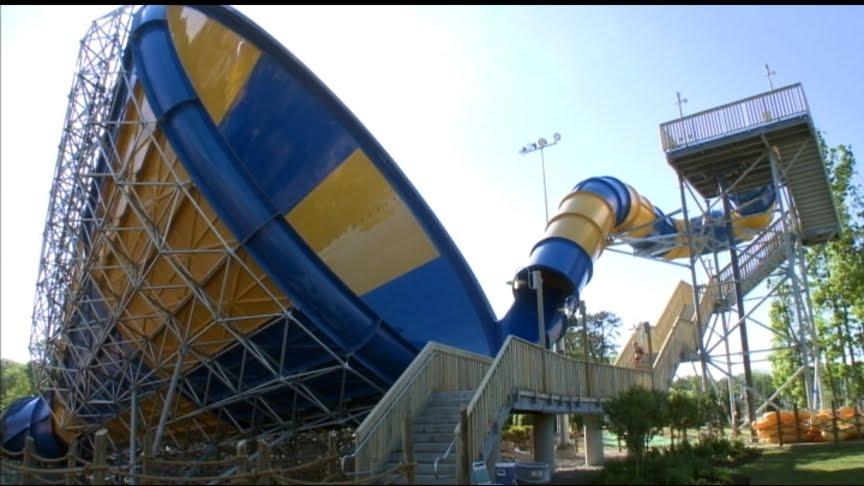
Last week  we helped launch  THE TORNADO, at Six Flags' Hurricane Harbor, a giant, blue and yellow, funnel shaped water slide, 132 feet long and 7 stories tall!


We were asked to create an HD B-Roll package for a press event announcing the opening of the ride.  Originally, we had a four or five days to shoot, edit and deliver the images in a variety of formats, but some rainy weather and minor construction delays forced us to turn around the project in about 12 hours.

Nothing new for this type of project.

Sarah, our assistant, Arion Doerr and I arrived in Jackson early so that we could scope out the best camera angles.  As the ride was not yet open to the public, only park employees were allowed to use the slide.  Angel, Six Flags' Public Relations Manager and her assistant Jenn, lined up a few dozen volunteers.  Unfortunately, they would not available until around  3:00 p.m. that afternoon.

The temperature had already crept into the 90s.  Sun block and water were the first order of the day.

We were happy to run into a friend of ours, Ron Wyatt who is responsible for much of the park's photographic needs.  Talented photographer great disposition.  An invaluable combination.
Check out his work at www.ronwyattphotos.com

Not until we got right up to it did we realize the immensity of this ride.  It was huge!  It was also very wet, so we made sure that most of our gear would remain outside the splash zone.


We had brought along two Sony XDCAM cameras, the EX1 and an EX3.  The EX3 was my primary camera fitted with a Sony .8 wide angle lens.  The lens is remarkably sharp and it allows you to use the entire zoom range of your lens.  The EX1 we placed in a Ewa splash bag to create some POV footage.

My biggest challenge was the position of the sun.  By the afternoon, the sun was positioned high and behind the opening of the funnel, putting the interior of the ride in shade.  There was plenty of light, but the contrast between the walls of the funnel and the hole at the bottom was extreme.  Putting the camera on automatic would compensate for the brightness, but doing that meant that every time I panned passed the opening, everything else in the image would become dark.

The remedy was to keep the lens on manual and slowly rack the exposure as the ride reached the end.  It was a bit clutzy at first, but after a few tries I found the rhythm of the ride and everything balanced beautifully.

The riders pick up speed while in the tube and with a sharp drop, fly out of the shoot into the funnel.  Fortunately, there is a small rush of water before the raft arrives so it was a little easier to track them.


We gathered footage from every angle we could reach on foot and ladders and then Angel handed me a harness and then took me up on a high lift so that I could get an arial view.   Very cool!


I had previously prepared all the elements for the release.  All that was needed when we arrived home was to load the footage into Avid and pull the best takes.  Much more time was spent watching files compress.

There is still much confusion when it comes to which HD formats television stations will accept and some smaller stations, are still not using HD at all.  Sarah prepared disks with a variety of formats so that there would be plenty of options for the editors.

She delivered the project early the following morning, to guarantee it's safe and timely arrival and we were delighted to see our footage show up on ABC's Good Morning America the following day.

Thanks Angel!

www.duckyou.com
Chuck as a featured DP on Sony's VideON

www.sixflags.com

Wednesday, May 26, 2010

Packin' Heat


Just back from filming at the American Airlines Arena in Miami.   The arena is home to the Miami Heat basketball team and serves a large array of touring musical performers, as well as the Ringling Brothers circus.


Sony just worked with them on upgrading all their systems to HD and also installed an amazing digital signage system that works in nearly every area of the complex, including a giant mesh video screen on the exterior of the building and a massive conglomeration of screens and signs that hangs over the center of the arena floor.  

I flew down there with Dara and Rob from Sony to film a few interviews and collect enough B-roll to create a short doc on the success of the project.

The production team at the area has an amazing setup.  The video team broadcasts "Heat" games live to the web, as well as creating highlight and pre-game videos for TV.  They also produce a ton of  internal programing.  


Integrated with all the video production is the digital signage team and I have to say that their work was stunning.  The system (developed by  Sony) was called Ziris and it took the concept of the "video wall" to a much higher level, using 12 or more 60" LED screens mounted in various shapes and configurations.  The programmer was able to have a single image run across all the screens or have each screen with an individual image.  The combinations were endless and the connections were all web based, so changes could be made at any time, from nearly anywhere.


Dara arranged our lighting and grip from a local Miami company.  I brought the camera and audio gear from home, along a small pile of "just in case" items.  All of which ended up getting used at some point during the day.

I stuffed my EX3 into the same large Kata VB-26 back pack, camera bag that I used in Hershey, gambling that the flight team would not make me gate-check it due to its slightly larger-than-legal stature.  Still, it was not the largest carry-on being carried on.  Now 
that most airlines are charging for any bags you might check, flyers are going to ridiculous extremes to avoid fees.  Seems like I've been talking about packing a lot, but it's often the most complicated part of the production.  Especially when I'm flying.  


Despite the travelin' blues, the shoot was fun as each location added a new set of opportunities.  (That's corporate for problems). 


Each situation involved unique lighting, white balancing and audio and it made the day go by very fast.  I've been including a handy battery operated Lite Panel LED light s part of my regular kit and it is extremely handy as a small fill or kick light.  It was especially helpful while I was using the light from a computer screen as my main light and using the panel as a fill.  I also used a small ND grad filter, sideways on the lens, to knock down the screen's intensity. 


Back home in New Jersey and very happy that our friends at Sony are extremely happy with the two hours of footage that we gathered and we're looking forward to the next gig.     


All in all, a fun trip. 


www.duckyou.com
www.duckem.com 

Sunday, May 9, 2010

Why did Hershey call them Kisses?

Hersheypark: Part Two

 With our coaster POV shoot successfully behind us, it was now time to begin creating some additional HD B-Roll for the park's press reel.  

We spent spent the next few hours scouting locations with the public relations crew and Hersheypark's Rides Operation Manager.  Again, safety is paramount at Hersheypark so we had to seek out the best possible angles while maintaining a safe distance from each ride.  

The park is fairly large and some of the rides travel pretty far.  Our job at this point, was to determine where we needed to be to get the most exciting shots, in the least amount of time, keeping the sun at the proper angle.  We also needed to have a talent releases for each and every person on the ride we were filming.  Finally, to enhance the challenge, we had the threat of rain on the horizon.

As the park would have a few thousand guests while we were filming, we needed to travel light.  Time was limited and it was in our best interest to carry all of our gear to each and every location.  Running a quarter mile around a wood roller coaster to chase down an accessory was simply not an option.

After having great success traveling with a Kata backpack on a recent trip to Africa, it was a no-brainer to try out their slightly larger Kata VB-510.   


This backpack/camera bag was able to hold our primary camera, a Sony EX3 HD camera with a full Chroisziel matte box and rails mounted to the camera.  It also held a wide angle lens, four batteries, six SxS cards, two Lite Panels, six Panavision size Formatt grad filters, a Sony ECM-674 shotgun microphone,  an ECM-77B lav mic, headphones, cleaning cloths, sunblock and a small bottle of Tylenol.   


All of this, along with a Manfrotto 536 carbon fiber tripod with 526 fluid head was carried by our virile young assistant Arion Doerr and might I add, without much complaining.  Perhaps it was the Hershey bars we kept dangling in front of him.

The bottom line is that we had a production company in a bag and we were able to shoot for hours without any interruption.

We actually started gathering our B-Roll outside the park at the corner of E. Chocolate Ave and Cocoa Avenue.  On some days the air is so thick with the smell of chocolate that its probably fattening.


We were directly across from the famous Hershey chocolate factory and were informed that they still make Hershey Kisses right there in the plant, the same way they've made them for years.  Milton Hershey, the legendary founder of the company named them Kisses, because the machine produced a smacking sound  every time a Kiss was created.


On more than one occasion, the extreme height of the Manfrotto sticks was a life saver.  Several locations required higher vantage points and there would have been no way to keep a small camera like the EX3 steady, hand-held.  Especially, at extreme telephoto focal lengths, such as filming the cars at the peak of the Fahrenheit and Lightning Racer coasters.  


Although much of our shooting would be on tripods, filming Fahrenheit required that I hand-hold the camera.  The EX3 is a bit of a dog hand-held, without some type of additional shoulder mount hardware.

Sarah had hired a Vari-Zoom Steady Rig from a NYC rental house.  It was one of the klutzy-est devices I have ever attempted to use and in fact, we didn't bother bringing it with us to Hershey.  It might have worked fine if I was walking around trying to be a human tripod, but to follow a speeding car around a coaster, well, there was just know way it would work. I ended up mounting a small, $ 10.00 pistol grip on the end of rails that support my matte box and it worked fine.


You can easily twist into a pretzel or at the least, lose your balance trying to follow Fahrenheit with a camera.  Fortunately, the EX3 with its simple pistol grip worked brilliantly this time around.  It was certainly much easier than using a large shoulder mount camera.


Click here to see the edit combining the exterior B-Roll with the POV shots:

We had a very successful morning of filming, but sadly, as our lunch break approached so did the rain.  Rides look pretty bleak against a while sky, so we'll have to schedule another day.  

When we returned home, I embarrassingly empty my pockets of reams of silver foil. 
Ah yes.  The diet starts again on Monday.   


Monday, May 3, 2010

Filming "The Sweetest Place on Earth"

Last week, Sarah and I, along with our freelance assistant Arion Doerr, traveled out to Hershey Pennsylvania. Hershey, Pa is the home of Hershey chocolate and Hersheypark and we were there to create some HD POV B-Roll at on two of their roller coasters, Fahrenheit and Storm Runner.  

If you haven't already guessed, POV is the acronym for point of view and that means we needed to mount HD cameras on the first car of each ride to show what a park visitor will experience sitting in the front seat.

This in itself creates a challenge.  The cars on which the cameras are to be mounted were designed to carry riders safely around the track, but they were not necessarily designed to have cameras mounted on them.  And while my cameras are capable of creating beautiful HD images under some extreme conditions, I'm fairly confident that they were not designed to be subject to the physical stress these rides can demand.

Fortunately, we've had prior experience mounting our cameras on several high speed coasters, including Six Flags Great Adventure's  Kingda Ka, the tallest and fastest coaster in the world.

Our first concern is safety.  Not just the safety of our cameras, but the safety of everyone working on the crew, everyone around the coaster and of course, the coaster itself.  We did not make a move without the approval and oversight of the park's ride technicians.  This is a multi-million dollar investment that they were letting us work on and they wanted us to leave it, and everyone around it, just the way we found it.

We had brought two cameras with us to Hershey, a Sony EX3 and a Sony MC1.  The EX3 was our primary camera and we brought it along to create B-Roll of the exterior of the rides and surrounding park areas.


The MC1 is a unique HD camera in that its lens and body are separate from each other, connected by a six foot tether.  This makes the camera head extremely small, light-weight and easy to mount almost anywhere.  It also allowed the addition of filters and wide angle lens adaptors.   For better audio, I had Arion tape a small piece of windscreen foam over the built-in microphone to help minimize wind noise.

The recorder part of the system uses readily available AVCHD cards or Sony memory sticks.  It fits easily in your palm and includes a built in HD monitor with a touch screen that controls all camera and recorder functions.

Both the MC1 and EX3 are file based systems, which means no video tape.  This is important when filming rides.  The tape drum in the camera spins like a gyroscope and hard turns are very difficult for the camera's tape and mechanical system.  A spinning gyro doesn't like being forced off its current direction.


The built in screen was very important to us, as it allowed us to check the position of the camera as we were mounting it, as well as giving us a confidence check after each run of the ride.  The torque during launch and many of the ride's turns and corkscrews can easily alter the alignment of the camera.  Being able to rapidly check the previous shot, without having to remove a card and download the shot to a computer saved us considerable time and helped us travel lighter, as well.


I used a Manfrotto 405 geared head bolted to a 2x4 to hold our camera head.  We needed a mounting device that could be delicate enough to give us critical, reposition-able movements while aligning the camera head with enough strength to hold the camera in place.  I've been using the 405 to hold a Sinar 4x5 for years, so I knew it would hold our cameras securely.  The quick-release plate was an essential part of the process and made it possible to remove the camera without undoing everything else.

The 2x4 was clamped and bungeed to the ride with the tripod head positioned between the two front seats.  Once in place, nylon zip ties and sash cord were used as a backup on each and every element, ensuring that even if the mount should fail or come loose in transit, it would remain securely in place.

The wood 2x4 also acted as a bit of a shock absorber.  I wanted the image to be steady, but not to look like it was floating.  On the contrary, although I wanted some vibration to show through, I didn't want it to all be a blur.   So, the wood base was a perfect compromise.  It was also light and easy to install across two seats.


Regardless of our care and concerns for safety, my heart is always in my throat when the camera launches for the first time.  Seeing it come back into the station, in one piece.. still functioning,  always brings a sigh of relief.

Check out the Fahrenheit POV here

The end results were worth the effort and hearing "I love it!" from my client was simply icing on the cake.

Of course, that would be Hershey's chocolate icing.

www.hersheypark.com
www.duckyou.com
Chuck is a featured DP on Sony's Videon Site
www.duckem.com

Sunday, April 11, 2010

It Was a Dark and Stormy Night. Really!


It’s 2am and I’m anxious for the LBI lighting crew to lift a half-ton truss of colored spotlights 30 feet above me.  I'm time-lapsing the building of a stage and two hours had passed with little movement.

Time-lapse gets pretty dull when nothing moves.

Although tonight’s installation is for the launch of a new product, it will still be quite an extravaganza of smoke, light and sound.  A rock show without the band.

One of my first time-lapse project was for a production company working with U2.  The group was slated to appear at Giant’s Stadium deep in the New Jersey Meadowlands at the beginning of their Stadium Zoo Tour.  A producer named Ned from Dreamchaser Productions in Dublin, Ireland called looking for someone to do the deed.

I asked, “What does it pay?” and he responded "Six grand.",  after which I suggested that I was the perfect one for the job.

I ran off to buy my first time-lapse camera and as such, began my new specialty.

On the early gigs I was using inexpensive super 8 film cameras, often with as many as 6 to 10 cameras in use at any one time.  Each camera needed to be locked at a fixed position and was usually mounted on a tripod or a super clamp, pointing in the direction where different events were presumed to unfold.

Time lapse, for those unaware of the technique, is the process of shooting one image at a time at a set rate, say, one frame every five seconds and then playing it back at the normal speed for the format you are shooting in.  For film it would be 24 frames per second (fps) and if you are shooting video, it is usually 30 fps.  The result is that everything you have filmed is now showing up at a much faster rate.  Clouds form and zoom by the camera at breakneck speed, city traffic will race down the streets and with amazing grace, flowers bloom in seconds.  

Often, the difficulty in creating a time-lapse is having the patience to wait for an event to unfold.

At times, it works out just right and another time someone might park a truck right in front of your shot and kill it, but the results are worth the challenges, as time lapsed images can be both beautiful and fun.  The simplest movement can take on new life when ramped up several times its normal speed.

The first time lapse films that I worked on only used one camera.  It was locked in a singular position and from that one angle, you might witness the construction of a building or amusement park ride while shadows shifted from west to east and clouds flew by.  This type of rig became pretty boring to me after a while and soon after, I began using several cameras so that later, I could edit between the camera positions.  This, along with a cool music track created a fun experience.


Eventually, I began to walk around, placing cameras in  multiple locations in the hopes of capturing short term movement.  Like a back-hoe digging a foundation or a steel column being lifted into position.   I would spend many hours walking between the different cameras to make sure they were still working, that there was still enough film or tape left and finally, to check that their position was still valid.

Time lapsing the construction of a roller coaster for Six Flags was a fairly slow moving process and in the case of Kingda Ka, the worlds tallest and fastest coaster, it took all of that winter.  As there was not enough money in the budget for us to be there daily, we would try to arrive on days that a major element of the ride, like a giant piece of steel was about to be lifted into place and it always seemed to happen at first light.  We froze our butts off.

Still, Sarah and I rarely found it boring and it became a challenge anticipating how the slow moving action in front of me would play out in high speed time lapse.


In the case of U2, time lapse was only part of the story.

It was day three at Giant Stadium and the rain had been coming down for hours.  My cameras were all wrapped in plastic bags and the summer heat was causing the lenses to fog.   Finally, there was a break in the weather and the backing tracks from “Real Thing” began to wail over the PA.  The band appeared on the B-stage which was situated out at the 50 yard line.  

I desperately wanted to get some close-up shots for myself, so with my small Hi-8 camera in hand, I slowly moved through the shadows towards the stage.  I had the Edge in my viewfinder when suddenly Bono abruptly raised his hand, halting the rehearsal. 

“You there, Mr Tiffen".  (I had a Tiffen hat on.)  "Is that an 8mm camera?".  He spoke very politely, but his voice boomed loudly over the monitors.  I was positive this could be heard on the NJ Turnpike.


I was like, “S***t!  Busted!”  

Then Bono gestured and asked “Wouldn’t your shot look better from up here?”

My eyebrows went up.  “Really?” 

At this very moment, my battery light is blinking and when I check, I find that I only have three minutes of tape left. 

Raising my finger I shouted “Just a minute!” and ran off to retrieve my case on the sidelines.  The band must of thought I was a lunatic.  To assure them that I was, I tripped and slid about 6 feet on the wet tarpaulin, camera held high like Miss Liberty.  


Standing up, I shouted "I'm good" and looked over to where I thought my assistant John Decker was standing with our gear, but he was no where to be seen.

I was mortified!  So now, with pants jacket soaked, I turned and ran back towards the stage.


Approaching the stage, Larry Mullen stepped out from behind his drums to give me a hand up to onto the platform after which the band finally went on with their practice while I proceeded to roll off those last three minutes of tape.  To be honest, it was so cool having them in my own viewfinder that I pretended to shoot for another five.  Then with a wave of thanks, I slipped back into the shadows.

I have worked on three different U2 tours since and fortunately, no one has ever reminded me of my brilliant slide, diagonally, across the forty yard line. 


Time lapse has become much more common since then and much simpler to achieve.  Many, simply shoot long clips with their video cameras and then speed up the footage in their non linear editing systems.  Others are using DSLR cameras to achieve the same technique by using the camera's built in intervalometer.  Regardless of the method, it's still important to think in time lapse to get the best results.

To see some of of our time lapse films, please visit our website at www.duckyou.com 

Back at the launch site things are finally getting back underway.   The chain drives above me have begun to grind and any second a 50 foot lighting truss will be lifted into position.  

Roll the cameras!

www.duckyou.com
www.duckem.com

http://pro.sony.com/bbsc/video/videon.do


Saturday, April 10, 2010

Family Matters

When I opened my first studio, I worked more hours than I ever could have imagined.  Sometimes, after photographing for an entire day, I would then spend hours in the darkroom printing all that I had shot.
Digital was still a long way off, but whether your hands are immersed in Dektol or your fingers are mousing away at Photoshop, time has a way off slipping by when you're concentrating on your work.

At 2 am, talk radio was not only a companion, it was the only thing keeping me awake, yet of all the hours I spent listening, only one program remains clear to this day.  I was listening to a radio host named Barry Farber and on this particular night he was talking about making a recording of his father.

Now in today's electronic world, picking up and using a video camera is a pretty common thing.  I mean most people's phones can shoot video now, but in the mid 1980s, the technology wasn't there and he was talking about using a audio cassette tape recorder.

But all technology aside, I found his discussion both brilliant and illuminating.  He was talking about recording the voice of his father so that future generations of his family could hear his voice and perhaps a little family history.  Something that more than often, gets lost.

You may have a recording of your grandmother holding your child as an infant, but what format is it on?. VHS?  VHS-C?  Hi-8?  Does that camera still work and if it does, will the tape still play after laying in the basement since you replaced it with a DVD player?

Many of us "filmmakers" have watched hours of documentaries on PBS or the History Channel television, but rarely have considered documenting our own histories?  And if so... Why not?

You might also be quite surprised at some of the things you learn about your grandmother or grandfather.  Believe it or not, they were kids once, too.

I have a friend named Rob Katz and he's made a business out of recording family histories.  He calls his company Small Talk Productions  Small Talk Website  and he creates delightful films about other folk's families.   He calls it "Oral Histories" and although Milton Shwartzberg might not have held the fate of the empire in his hands like Winston Churchill, his own life experiences might be just as interesting to his family.

I had the pleasure of filling-in as Rob's DP last year and to my surprise, it was an interesting shoot.  Rob's line of questioning was well researched both with other family members and the prevalent history during the time his subjects were growing up.  This gave them something to relate to and also helped jog their memory a bit.

I remember the sound and smell of the Revere projector that my father used to show us the family films.  There was always a mall amount of smoke rising above the machine as dust would burn off the bulbs.

One of the unique things about old style 8mm home movies, was that the camera carried a very short load of film.  Usually between 2:40" and 3:20", depending on the speed the camera was set to and due to the expense, it was pretty rare to simply blow an entire roll of film on one event.  So, it was not uncommon to find shots of birthdays, weddings, family outings, your grandparents the beach and Niagara Falls, all on one 50 ft. spool of film.

The jumping from subject to subject was part of the fun and we always knew what we were looking at because my mother and father would keep a constant narration in flow,  discussing how dirty the pool was or how much weight my aunt gained.

Which brings me back around to recording your family.

Wouldn't you like to know what your great great grandfather sounded like.  Don't you think your kids will, when they grow up?  Think ahead.


With the passing of my own mother, I now realize that my one year old daughter will probably not remember the sound of her grandmother's voice.  We will tell her all about grandma and there will be plenty of home movies and photographs, but it would have been nice to have an audio recording, as well.

My suggestion is to create a simple time capsule.  Include shots of the current objects in your living room or kitchen.  Include current events, like a newspaper heading and shots around your town.  It may seem like ordinary stuff now, but very shortly it will change and disappear or be covered up by something new.  Plan your shots well so that you can use them in your family documentary.

Who knows, maybe in a few years (when you become famous) the History Channel will come looking for your personal b-roll or at the least, it will be fun to look back and reminisce.

www.duckyou.com
www.duckem.com

Monday, April 5, 2010

Following the Footsteps of Robert Flaherty

I have a weather app on my iPhone that shows the current weather conditions in some of the more interesting locations that I have filmed or photographed at, outside the New York area.  Much of the time it is little more than a conversation piece between myself, Sarah and an assistant or two that traveled with me.  It’s fun to add a “weather snapshot” to a story I’m relating and this particular app cost under a buck.

Usually, if you’re down to talking about the weather, it is already pretty a boring conversation, except when the location is Igloolik.

I could have easily guessed from the name that we would not be filming in a tropical paradise, yet, it has to be one of the most beautiful locations I have had the privilege to film in.

To take a step back for a moment, a soft-spoken and often silent director brought me onboard the project after I had shot some interviews and B-Roll for him in Manhattan.  Mac Dara O’Curraidhn, was from Galway, in the west of Ireland.  He was working on a documentary that was following the footsteps of legendary filmmaker, Robert Flaherty.  

"Flaherty was an American filmmaker who directed and produced the first commercially successful feature length documentary film, Nanook of the North (1922).   Of the eleven completed filmed that Flaherty produced, only Nanook of the North had commercial success."

Something he desperately tried to reproduce in the other ten. 


Dr. Brian Winston, a brilliant, feisty little British gentelman, penned our script.  He is an Emmy winning writer, scholar and author of several books on the subject of film.  He was also the Dean of Communications, at the University of Lincoln, UK, and every conversation was truly a delight.  It was like having my own personal, college level film course and I was getting paid to attend.  Sweet!


My leg of the journey involved three of Flaherty’s films:  Nanook of the North, The Twenty-four Dollar Island and The Louisiana Story and I would be traveling to Hollywood, Boston, Vermont, Ottawa, Louisiana and of course, Igloolik.

Two of his other well-known films, Man of Aran and Moana were covered by local DPs, due to budget restrictions.

Twenty-four Dollar Island is a stoic, silent film shot mostly around New York Harbor.  The imagery was stark and dirty inspiring my first New York City film, STEAM View Steam


Mac Dara had begun the filming in PAL HDCAM and I rented a Sony F900 to film interviews and b-roll around Manhattan.  It was only after I showed him some footage from my Sony EX3 that he agreed to switch to XDCAM.  Fortunately the EX3 will film in PAL as well as NTSC.  That means more potential production work from a larger client base for us.

The Louisiana Story was more of a docu-fiction.  A propaganda film created by Flaherty for the Standard Oil Company, illustrating the virtues dropping wells all over the Louisiana bayou. 


So, Arion and I, along with Mac Dara and Kay, our production manager, traveled down to Avery Island, near Lake Charles, Louisiana, to interview the star of that film. 

The island held the locations for several scenes in the film.  It is also the home of Tabasco Sauce.  No matter where in the world you see it on your table, it came from Avery Island.   It was on their property we that we were filming, so, we stood in 90% humidity, in 90-degree shade, learning all about Tabasco sauce from the company’s historian.   

Avery Island is one of the weather locations on my phone.


The lead character in The Louisiana Story was around 12 when the film was made.  Now, he was in his 60s.  He and his wife were absolutely charming.  They lived in a small white trailer, surrounded by dozens of chickens, which made for a very lively audio track. 

Mac Dara interviewed him about the making of the film and then we drove to the site where, in the film, he allegedly fought with an alligator.  I filmed a few alligators, turtles and spiders of my own to mimicing some of the shots in Flaherty's film.

A few days later, we were to head up towards Ottawa to film Flaherty's granddaughter and then further north to Igloolik, deep within the Arctic Circle.

On occasion, the Canadian government can be fairly strict when it comes to working and filming permits, which I found out late in the game, had not been obtained.  After some heated discussion, it was decided we would cross the boarder as tourist/filmmakers, rather than an actual crew.   In the future, I sincerely recommend getting the permits to avoid any hassles and the very real possibility of being sent back home at your own expense.

Igloolik is a small village in the northern most part of Hudson Bay.  It took us three flights to get there and at each leg of the journey, the airports and the airplanes, each got much smaller. 

It was early spring, so the temperature was a hearty 20-degrees.

A few weeks prior to the trip, Kay informed me that the local food consisted of fish and decayed walrus meat.  As I am allergic to fish and thought of walrus was iffy, I packed plenty of instant soup and energy bars.  Upon arriving, we toured the town and found their local market stocked with every product Oscar Mayer and Sarah Lee, ever sold.  

Food was no longer an issue, although, clothing still was.

The local Inuit people are quite used to the cold and laughed when they saw what we considered to be “extreme weather” clothing.  I don’t remember the exact word they used, but “gringo” would be a safe substitute.


A short while later, Kay arrived with special cold-weather coats, pants and boots for our journey out onto the ice.  The coats were big, bulky with a fur-lined hood and remarkably warm, like the type you’d see in National Geographic magazine.  Apparently, many geese gave up their feathers for our comfort and safety.


Our sled, little more than a plywood box on skids, sat about 60 feet off the shore, tethered not to a team of huskies, but to a snowmobile driven by our guide, Jason Kannuk.  As the rope became taught, we jerked into motion, bouncing over large ice shards and crevices broken only by an occasional glide through a large, turquoise pool of water.  All very exciting in the beginning, but a bit tiring as the hours moved on.


Mac Dara wanted to film seal and walrus at the edge of the ice and although we saw many off in the distance, they all made a quick escape through small holes in the ice as we approached.  We settled for filming our guides fishing for Atlantic Char in the icy waters of a snow-banked stream on a nearby island.  Still, quite dramatic and preferred over the clubbing of seals.


For this leg of the journey, I chose to bring the Sony EX1 and a smaller Manfrotto tripod.  Space was very limited on the smaller aircraft and as usually, I refuse to check my cameras into cargo for safety reasons.  Although the camera returned stunning images, it was perhaps the wrong camera for this particular occasion.  The bright ice made it difficult to focus using the camera’s monitor and the rear viewfinder was not yet improved as it has been on the EX1R.  At times, simple shooting was a bit of a challenge and I longed for the EX3's viewfinder and long lens capabilities.


The upside of filming in the arctic this time of year is that the sun continually remains in the sky 24 hours.  Our production day was endless.   Unfortunately, our energy was not and at one point, after schlepping camera and tripod through snow up to our waists in winds upwards of 30 mph, Arion and I were exhausted.  Partially, from laughing about it.

After one additional, 20 minute interview, we bid our friends goodbye, got back in our sled and made the three-hour journey back to the village.  The bumping across the ice seemed endless, but we finally reached the shores of Igloolik.  A warm shower, a hot meal and we hit the sack.

The documentary is near completion and will be aired on the BBC and many other stations around the world.   I’m really proud to have been a part of it.

On really cold days, Sarah and I laugh about the fact that it is probably colder in Igloolik and she pulls out her Iphone to prove it.  Even though we are heading into the warm days of spring, I still miss that arctic explorer coat.

www.duckyou.com
www.duckem.com